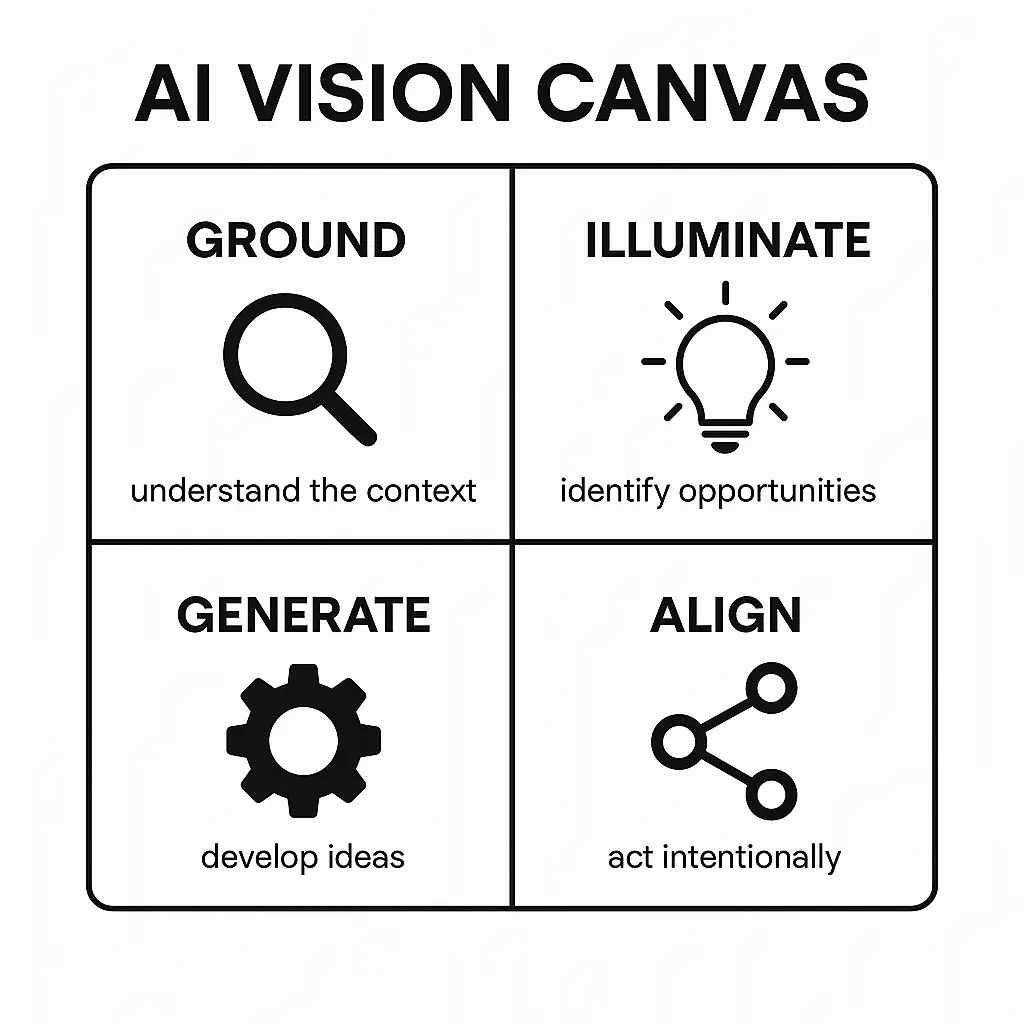
Implementing an AI strategy can transform your small business by improving efficiency, reducing costs, and driving innovation. This four-step AI roadmap, Ground, Illuminate, Generate, Align, provides a clear path to plan, pilot, and scale AI solutions that deliver real business value.
Understanding Your Starting Point with Ground
Before investing in AI tools or hiring data experts, conduct a comprehensive audit of your current processes, data assets, and team capabilities. An effective Ground phase includes:
-
Process mapping to identify repetitive tasks and data silos
-
Stakeholder interviews to capture pain points and high-priority needs
-
Data inventory to assess quality, availability, and gaps
When you tie your small business AI strategy to concrete objectives—like increasing sales conversion or automating customer support—you ensure each AI investment aligns with measurable goals.
Prioritizing High-Impact Use Cases in Illuminate
Not every AI idea delivers equal value. Use an impact-versus-effort matrix to rank potential AI projects by expected return on investment and technical feasibility. Prioritization criteria include:
-
Estimated cost savings or revenue lift
-
Data maturity and accessibility
-
Team skills and resource availability
Focus on three pilot AI use cases—such as automated email personalization, basic demand forecasting, or chatbot support—that balance quick wins with scalable potential. This targeted approach accelerates ROI and builds internal confidence.
Rapid Prototyping and Validation in Generate
With your top use cases selected, move quickly into lightweight pilots. The Generate phase emphasizes:
-
Minimum viable AI models built with low-code platforms or open-source libraries
-
Clear success metrics, such as accuracy thresholds, time saved, or user satisfaction scores
-
Short development sprints (2–6 weeks) to test assumptions and gather feedback
By prototyping fast and measuring results, you can validate your AI hypotheses, adjust data inputs or algorithms, and decide whether to expand or pivot without heavy upfront investment.
Scaling and Governance in Align
A successful AI pilot must transition into a governed, repeatable process. The Align phase establishes:
-
Integration plans to embed AI solutions in production workflows, including staff training and change management
-
AI governance policies defining roles, responsibilities, and review cadences for model performance and ethical compliance
-
A balanced scorecard tracking both financial outcomes—like cost reduction or revenue growth—and human-centered metrics such as adoption rates and customer satisfaction
Effective governance ensures your AI roadmap remains aligned with evolving business needs and regulatory requirements, setting the stage for continuous innovation.
Best Practices for Small Business AI Strategy
-
Start small and iterate: Focus on one high-value use case, refine based on real feedback, then expand.
-
Leverage low-code and managed services: Reduce development time and technical barriers by using prebuilt AI tools.
-
Measure the right KPIs: Track both operational metrics (time saved, error reduction) and business outcomes (revenue impact, customer retention).
-
Foster cross-functional collaboration: Involve IT, operations, marketing, and leadership to ensure broad buy-in and shared ownership.
-
Document and share learnings: Create internal playbooks and run “lunch-and-learns” to spread AI literacy and best practices.
Next Steps: Launch Your AI Roadmap
Ready to build your AI strategy and roadmap? Then schedule a strategy session to tailor this four-step plan to your small business goals and budget.